AWS Certification Roadmap
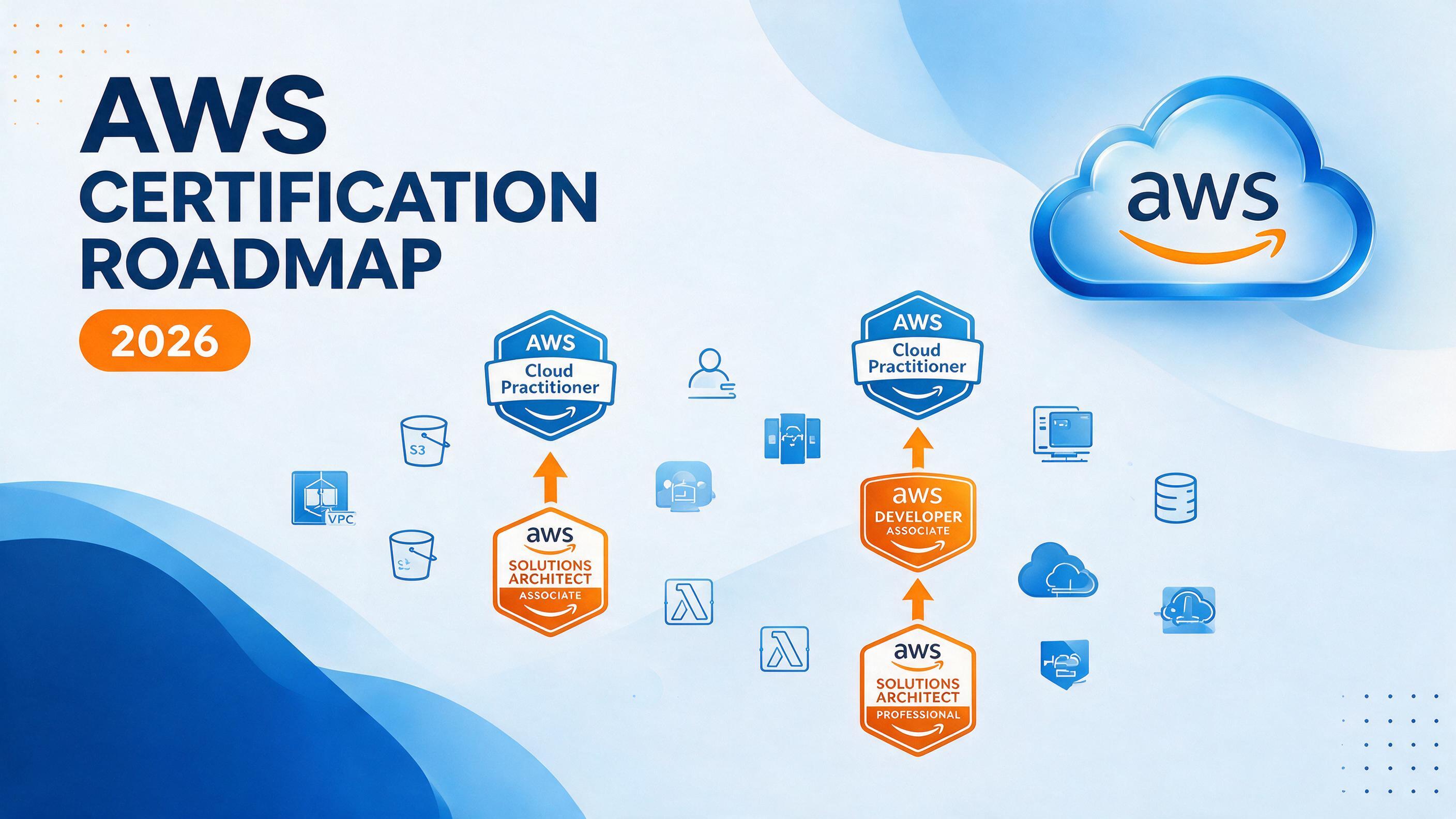
AWS certifications, exam codes, and exam versions change periodically. Always confirm current details on the official AWS Certification page and the relevant official exam guide before registering.
Start by matching a certification to your current job tasks, not your job title. Beginners and non-technical career changers usually start with AWS Certified Cloud Practitioner (CLF-C02), then move to a role-based Associate exam (Solutions Architect, Developer, CloudOps Engineer, Data Engineer, or Machine Learning Engineer). Technical professionals with hands-on AWS experience can often skip straight to the Associate exam that matches their role, then progress to Professional or Specialty certifications as their responsibilities grow. Always confirm the current exam guide before you commit to a study plan.
Why an AWS Certification Roadmap Matters
Amazon Web Services now maintains a fairly wide certification portfolio spanning foundational knowledge, role-based Associate credentials, advanced Professional exams, and deep-dive Specialty exams. AWS offers role-based and specialty certifications that let professionals validate their cloud expertise with an industry-recognized credential. That breadth is useful, but it also means a learner who picks an exam at random can easily end up studying the wrong material for their goals, or attempting an exam that assumes experience they haven't built yet.
A roadmap solves this by working backward from two questions: What do I actually do (or want to do) day to day on AWS? and How much hands-on AWS time do I already have? The right certification depends on your current role, your target role, and the amount of study time you can realistically commit — not on which exam is trending on social media.
AWS itself removed formal prerequisites from its certifications years ago, so in most cases nothing technically stops you from registering for any exam. That doesn't mean every exam is a good idea at every stage — an exam guide's "target candidate description" is a strong signal of readiness even when it isn't a hard requirement.
One more note before you plan a study schedule: AWS periodically retires, renames, or replaces exams as its services evolve. This article reflects the certification portfolio as published in AWS's official exam guide index as of August 2026, but you should re-check the official exam guide index before registering, since AWS may update this information at any time.
Quick AWS Certification Roadmap
These are sensible starting sequences, not mandatory prerequisites — verify against the official AWS certification page if you want to confirm whether a specific exam has any formal requirement.
| Your track | Suggested sequence | |||||||
|---|---|---|---|---|---|---|---|---|
| Beginner / non-technical | Cloud Practitioner (CLF-C02) → a role-based Associate exam | |||||||
| Architect | Solutions Architect – Associate (SAA-C03) → Solutions Architect – Professional (SAP-C02) | |||||||
| Developer | Developer – Associate (DVA-C02) → DevOps Engineer – Professional (DOP-C02) or Generative AI Developer – Professional (AIP-C01) | |||||||
| Operations | CloudOps Engineer – Associate (SOA-C03) → DevOps Engineer – Professional (DOP-C02) | |||||||
| Data | Data Engineer – Associate (DEA-C01) → deeper data/analytics specialization as your role demands | |||||||
| AI / ML | AI Practitioner (AIF-C01) → Machine Learning Engineer – Associate (MLA-C01) or Generative AI Developer – Professional (AIP-C01) | |||||||
| Security | Cloud Practitioner or a technical Associate foundation → Security – Specialty (SCS-C03) | |||||||
| Networking | Solutions Architect Associate or a networking foundation → Advanced Networking – Specialty (ANS-C01) |
| Level | Best for | Typical focus | Example certifications | Recommended preparation approach |
|---|---|---|---|---|
| Foundational | People new to cloud, non-technical stakeholders, career changers | Cloud concepts, AWS terminology, high-level service awareness | Cloud Practitioner, AI Practitioner | Free digital training, official practice question sets, light hands-on exploration in the AWS console |
| Associate | People performing a specific technical role (architect, developer, operations, data, ML) | Applied use of core services for that role | Solutions Architect Associate, Developer Associate, CloudOps Engineer Associate, Data Engineer Associate, Machine Learning Engineer Associate | Structured domain-by-domain study, hands-on labs, scenario-based practice questions |
| Professional | Experienced practitioners handling complex, multi-service, enterprise-scale problems | Trade-offs across many services, automation, governance at scale | Solutions Architect Professional, DevOps Engineer Professional, Generative AI Developer Professional | Deep hands-on project work, architecture-diagram practice, timed mock exams |
| Specialty | People who want to prove deep expertise in one technical domain | A single domain studied in significant depth | Security Specialty, Advanced Networking Specialty | Domain-specific labs plus general AWS experience as a base |
AWS Certifications List
The table below reflects the certifications published on AWS's official exam guide index. AWS regularly retires and replaces exams — a certification not in this "active" table may have been retired or is in a transition window; see the Retired and Legacy Exams section further down.
3. Foundational Certifications
| Certification | Exam code | Best suited for | Suggested starting point | Main preparation focus |
|---|---|---|---|---|
| AWS Certified Cloud Practitioner | CLF-C02 | Beginners, non-IT professionals, managers, sales/support staff | First AWS exam for almost everyone with no cloud background | Core AWS concepts, billing, shared responsibility, high-level service categories |
| AWS Certified AI Practitioner | AIF-C01 | Business and technical professionals who need AI/ML literacy | Good first exam for non-ML roles who work alongside AI initiatives | AI/ML concepts, generative AI use cases, responsible AI, high-level AWS AI services |
4. Associate Certifications
| Certification | Exam code | Best suited for | Suggested starting point | Main preparation focus |
|---|---|---|---|---|
| AWS Certified Solutions Architect – Associate | SAA-C03 | Aspiring and practicing solutions architects, generalist cloud engineers | The most common second certification after Cloud Practitioner | Designing resilient, secure, cost-optimized, performant architectures |
| AWS Certified Developer – Associate | DVA-C02 (transitioning — see note below) | Software developers building on AWS | Developers moving from on-prem or general coding into AWS-native development | Application services, deployment, debugging, security for applications |
| AWS Certified CloudOps Engineer – Associate | SOA-C03 | Systems administrators, operations engineers | Ops-focused professionals who deploy and manage AWS workloads | Deployment, monitoring, management, and operational troubleshooting |
| AWS Certified Data Engineer – Associate | DEA-C01 | Data engineers, ETL developers, analytics engineers | Engineers building data pipelines on AWS | Data ingestion, transformation, storage, and pipeline optimization |
| AWS Certified Machine Learning Engineer – Associate | MLA-C01 | ML engineers, developers operationalizing ML models | Practitioners who build, deploy, and maintain ML solutions | ML pipeline implementation, deployment, monitoring, and maintenance on AWS |
5. Professional Certifications
| Certification | Exam code | Best suited for | Suggested starting point | Main preparation focus |
|---|---|---|---|---|
| AWS Certified Solutions Architect – Professional | SAP-C02 | Experienced architects managing complex, multi-account environments | After Solutions Architect Associate plus real-world architecture experience | Enterprise-scale design, migration strategy, governance, cost and operations at scale |
| AWS Certified DevOps Engineer – Professional | DOP-C02 | Experienced DevOps engineers | After Developer Associate or CloudOps Engineer Associate plus hands-on automation experience | CI/CD, infrastructure as code, monitoring, incident response, governance |
| AWS Certified Generative AI Developer – Professional | AIP-C01 | Developers building production generative AI applications on AWS | After AI Practitioner plus hands-on experience building with foundation models | Designing, implementing, and deploying generative AI solutions, commonly involving Amazon Bedrock |
6. Specialty Certifications
| Certification | Exam code | Best suited for | Suggested starting point | Main preparation focus |
|---|---|---|---|---|
| AWS Certified Security – Specialty | SCS-C03 | Security engineers, security-focused cloud engineers | After an Associate-level foundation plus security experience | Data protection, identity, detection, incident response, infrastructure security |
| AWS Certified Advanced Networking – Specialty | ANS-C01 | Network engineers designing hybrid and complex AWS network architectures | After Solutions Architect Associate plus networking experience | Hybrid connectivity, advanced VPC design, network security, automation |
Certification-by-Certification Explanation
For every official exam-domain breakdown, treat the exam guide linked from each certification's official AWS page as the authoritative source — the summaries below describe general focus areas, not verified domain percentages.
AWS Certified Cloud Practitioner (CLF-C02)
Validates: A high-level understanding of AWS Cloud concepts, services, security, and billing. This exam is designed for candidates new to cloud who may not have an IT background, and it validates a foundational, high-level understanding of AWS Cloud, services, and terminology.
Who should take it: Total beginners, non-technical staff, managers, sales and support teams who work near cloud teams.
Recommended background: None formally required — check the official exam guide for the current target-candidate description.
Core areas to study: Cloud concepts, the shared responsibility model, core services (compute, storage, database, networking at a conceptual level), billing and pricing, basic security.
Hands-on projects: Explore the AWS Free Tier console, launch a small EC2 instance, create an S3 bucket, review the Billing dashboard.
Common mistakes: Memorizing service names without understanding what problem each service solves; skipping the shared responsibility model, which shows up repeatedly.
Suitable next certification: A role-based Associate exam that matches your target job.
Level: Beginner. Practice question style: Conceptual, scenario-light multiple choice/multiple response.
Realistic preparation range: Often a few weeks of part-time study for someone with no IT background; less for candidates already comfortable with general IT concepts. This is a general planning range, not a guarantee.
AWS Certified AI Practitioner (AIF-C01)
Validates: Foundational understanding of AI, ML, and generative AI concepts and use cases. This exam is intended for individuals who want to demonstrate their ability to understand AI, ML, and generative AI concepts and use cases.
Who should take it: Business analysts, product managers, and technical staff who need AI literacy without deep ML engineering skills.
Recommended background: None formally required.
Core areas to study: AI/ML fundamentals, generative AI concepts, responsible AI, high-level AWS AI/ML services.
Hands-on projects: Try Amazon Bedrock's console playground with a foundation model; explore Amazon SageMaker Studio at a beginner level.
Common mistakes: Treating this as a coding exam — it is largely conceptual.
Suitable next certification: Machine Learning Engineer Associate or Generative AI Developer Professional, depending on direction. Level: Beginner.
Practice question style: Concept-recognition and scenario-based use-case matching.
Realistic preparation range: Several weeks of part-time study is a common planning range for most candidates; verify against your own comfort with AI concepts.
AWS Certified Solutions Architect – Associate (SAA-C03)
Validates: Technical skills in designing distributed systems on AWS, aimed at individuals who perform a solutions architect role, validating the ability to design solutions based on the AWS Well-Architected Framework.
Who should take it: Aspiring or practicing solutions architects, cloud engineers, generalists who want AWS's most widely recognized credential.
Recommended background: Familiarity with core AWS services from hands-on practice.
Core areas to study: High availability and resilience, security architecture, cost optimization, performance, storage and database selection, networking basics.
Hands-on projects: Build a highly available web application across multiple Availability Zones; design and deploy a VPC with public and private subnets.
Common mistakes: Studying services in isolation instead of practicing the trade-off reasoning the exam actually tests (why choose one service or design pattern over another).
Suitable next certification: Solutions Architect Professional, or a Specialty exam aligned to your focus area.
Level: Intermediate.
Practice question style: Scenario-based, often presenting a business requirement and asking for the best-fit architecture.
Realistic preparation range: A commonly cited planning range spans one to a few months of part-time study depending on existing hands-on experience — this is not a guarantee of readiness.
AWS Certified Developer – Associate (DVA-C02, transitioning to DVA-C03)
Validates: Technical skills in developing and maintaining applications on AWS, intended for individuals who perform a developer role and validates proficiency in developing, deploying, and debugging cloud-based applications The incoming DVA-C03 version is described by AWS as also covering the use of AI-assisted development tools.
Who should take it: Software developers building applications on AWS.
Recommended background: Programming experience in at least one AWS-supported language.
Core areas to study: Application services (compute, serverless, containers), data stores relevant to application development, security for applications, deployment and CI/CD basics, debugging and troubleshooting.
Hands-on projects: Build and deploy a serverless API with AWS Lambda and Amazon API Gateway; containerize an application and deploy it.
Common mistakes: Focusing only on infrastructure design (a Solutions Architect skill) instead of the developer-centric services and workflows this exam actually tests.
Suitable next certification: DevOps Engineer Professional or Generative AI Developer Professional.
Level: Intermediate.
Practice question style: Code- and service-behavior scenarios, often including short code or configuration snippets.
Realistic preparation range: A commonly cited planning range is one to two months of part-time study for developers with some AWS exposure; treat this as a planning estimate only.
AWS Certified CloudOps Engineer – Associate (SOA-C03)
Validates: Technical skills in deployment, management, and operations on AWS, intended for individuals who perform a systems administrator role and validates the ability to deploy, manage, and operate workloads on AWS.
Who should take it: Systems administrators and operations engineers responsible for day-to-day AWS operations.
Recommended background: Operational experience with Linux/Windows systems and general IT operations.
Core areas to study: Monitoring and logging, deployment and provisioning, high availability, security and compliance operations, cost and performance management.
Hands-on projects: Set up centralized monitoring with Amazon CloudWatch; build an automated backup and recovery process.
Common mistakes: Underestimating the exam's coverage of automation and monitoring tools in favor of manual console tasks.
Suitable next certification: DevOps Engineer Professional.
Level: Intermediate.
Practice question style: Operational troubleshooting scenarios.
Realistic preparation range: Commonly a month or two of part-time study for candidates with operations experience; a general estimate, not a guarantee.
AWS Certified Data Engineer – Associate (DEA-C01)
Validates: Technical skills in implementing data pipelines and data stores on AWS, intended for individuals who perform a data engineer role and validates the ability to implement data pipelines and optimize cost and performance.
Who should take it: Data engineers and ETL developers.
Recommended background: Experience with data pipeline concepts and at least one data processing framework.
Core areas to study: Data ingestion and transformation, data store selection, pipeline orchestration, data quality and governance, cost/performance tuning.
Hands-on projects: Build a data lake using Amazon S3, AWS Glue, and Amazon Athena; build an ingestion pipeline with Amazon Kinesis.
Common mistakes: Ignoring cost-optimization questions in favor of pure technical implementation.
Suitable next certification: A data-focused specialization as your role develops, or Machine Learning Engineer Associate if you move toward ML pipelines.
Level: Intermediate.
Practice question style: Pipeline-design and troubleshooting scenarios.
Realistic preparation range: A commonly cited range is one to two months for candidates with data engineering background — a planning estimate only.
AWS Certified Machine Learning Engineer – Associate (MLA-C01)
Validates: Technical skills in implementing ML solutions on AWS, intended for individuals who perform an ML engineer role and validates the ability to implement, deploy, and maintain ML solutions.
Who should take it: ML engineers and developers who operationalize machine learning models.
Recommended background: Some hands-on experience with Amazon SageMaker or a similar ML workflow.
Core areas to study: Data preparation for ML, model training and tuning, deployment, monitoring and maintenance of ML systems.
Hands-on projects: Train and deploy a model end-to-end using Amazon SageMaker; set up model monitoring for drift detection.
Common mistakes: Studying ML theory in isolation from the AWS services that operationalize it.
Suitable next certification: AWS Certified Generative AI Developer – Professional.
Level: Intermediate. Practice question style: Applied ML-workflow scenarios on AWS services.
Realistic preparation range: Commonly cited as one to a few months depending on existing ML and SageMaker exposure — a general planning estimate.
AWS Certified Solutions Architect – Professional (SAP-C02)
Validates: Advanced technical skills and experience in designing distributed applications and systems on AWS, intended for individuals who perform a solutions architect role with two or more years of hands-on experience.
Who should take it: Experienced architects handling multi-account, multi-region, enterprise-scale environments.
Recommended background: Real-world architecture experience beyond the Associate level, per AWS's own target-candidate description.
Core areas to study: Complex migrations, multi-account governance, cost optimization at scale, resilience and disaster recovery, organizational security controls.
Hands-on projects: Design a multi-account landing zone; build a cross-region disaster-recovery architecture.
Common mistakes: Attempting this exam directly from Cloud Practitioner-level knowledge without the years of practical architecture work AWS's guide describes.
Suitable next certification: A Specialty certification aligned to a domain you work in regularly (Security or Advanced Networking). Level: Advanced.
Practice question style: Long, multi-constraint scenarios requiring you to weigh several valid-looking options.
Realistic preparation range: Commonly cited as several weeks to a few months for candidates who already hold significant architecture experience — never a guarantee.
AWS Certified DevOps Engineer – Professional (DOP-C02)
Validates: Technical skills in provisioning, operating, and managing distributed application systems on AWS, intended for individuals who perform a DevOps engineer role with two or more years of experience.
Who should take it: Experienced DevOps engineers responsible for CI/CD, automation, and operational excellence.
Recommended background: Hands-on CI/CD and infrastructure-as-code experience, per AWS's target-candidate description.
Core areas to study: CI/CD pipeline design, infrastructure as code, monitoring and observability, incident and event response, governance and compliance automation.
Hands-on projects: Build a full CI/CD pipeline with automated testing and rollback; implement infrastructure as code with AWS CloudFormation.
Common mistakes: Treating this as a coding exam rather than an automation-and-operations exam.
Suitable next certification: A Specialty certification, or Generative AI Developer Professional if your work shifts toward AI-enabled applications.
Level: Advanced.
Practice question style: Multi-step operational scenarios involving pipelines, automation, and failure recovery.
Realistic preparation range: Commonly cited as a few months for candidates already doing DevOps work on AWS — a planning estimate, not a promise.
AWS Certified Generative AI Developer – Professional (AIP-C01)
Validates: Advanced technical skills and experience in designing, implementing, and deploying AI solutions on AWS, intended for individuals who perform an AI practitioner role with hands-on experience.
Who should take it: Developers building production-grade generative AI applications on AWS.
Recommended background: Hands-on experience building with foundation models, commonly through Amazon Bedrock.
Core areas to study: Prompt engineering and application design, retrieval-augmented generation patterns, responsible AI, deployment and monitoring of generative AI applications.
Hands-on projects: Build a retrieval-augmented generation prototype using Amazon Bedrock; deploy a generative AI application with guardrails and monitoring.
Common mistakes: Treating generative AI development as purely a prompting skill and skipping the AWS architecture and deployment components the exam covers.
Suitable next certification: A Specialty exam aligned to your broader infrastructure responsibilities.
Level: Advanced.
Practice question style: Applied scenario questions about designing and operating generative AI solutions on AWS.
Realistic preparation range: Because this is a newer certification, treat any preparation-time estimate cautiously and lean on the official exam guide's task statements to gauge your own readiness.
AWS Certified Security – Specialty (SCS-C03)
Validates: Expertise in securing AWS workloads and applications, intended for individuals who perform a security role and validates the ability to demonstrate knowledge of specialized data classifications and AWS data protection mechanisms.
Who should take it: Security engineers and cloud engineers with a security focus.
Recommended background: Hands-on security experience plus a technical Associate-level AWS foundation.
Core areas to study: Identity and access management, data protection, detection and incident response, infrastructure and network security, security automation.
Hands-on projects: Configure AWS Key Management Service (KMS) for encryption at rest; set up detection with Amazon GuardDuty and AWS Security Hub.
Common mistakes: Focusing only on IAM and neglecting detection/response services, which the exam also covers.
Suitable next certification: Advanced Networking Specialty if your role also touches network security, or Solutions Architect Professional for a broader architecture path.
Level: Advanced.
Practice question style: Incident-response and security-design scenarios.
Realistic preparation range: Commonly a few months for candidates with real security experience — a general planning range only.
AWS Certified Advanced Networking – Specialty (ANS-C01)
Validates: Advanced technical skills and experience in designing and implementing AWS and hybrid IT network architectures, intended for individuals who perform complex networking tasks and validates the ability to design and implement AWS and hybrid network architectures at scale.
Who should take it: Network engineers and architects working on complex, hybrid, or large-scale AWS network designs.
Recommended background: Networking experience plus an AWS architecture foundation.
Core areas to study: Advanced VPC design, hybrid connectivity (VPN, Direct Connect), network security, automation of network infrastructure, network troubleshooting.
Hands-on projects: Build a hybrid connectivity lab between an on-premises simulation and AWS; design a multi-VPC network with centralized egress.
Common mistakes: Underestimating how deep the exam goes into routing, DNS, and hybrid connectivity details versus general VPC basics.
Suitable next certification: Solutions Architect Professional, if you want to broaden beyond networking.
Level: Advanced.
Practice question style: Detailed network-design and troubleshooting scenarios.
Realistic preparation range: Commonly a few months for candidates with real networking depth — a general estimate, not a guarantee.
Retired and Legacy AWS Certifications
Several exams that appear in older study material, forum threads, and some URLs are no longer active AWS credentials. Do not build a 2026 study plan around these — they are listed here so you can recognize outdated material.
| Certification | Exam code | Status | Notes |
|---|---|---|---|
| AWS Certified Cloud Practitioner (legacy version) | CLF-C01 | Retired | Replaced by CLF-C02 |
| AWS Certified Solutions Architect – Associate (legacy version) | SAA-C02 | Retired | Replaced by SAA-C03 |
| AWS Certified SysOps Administrator – Associate / generic SysOps page | SOA-C02 | Retired / renamed | Replaced by AWS Certified CloudOps Engineer – Associate (SOA-C03) |
| AWS Certified Security – Specialty (legacy version) | SCS-C02 | Retired | Replaced by SCS-C03 |
| AWS Certified Advanced Networking – Specialty (legacy version) | ANS-C00 | Retired | Replaced by ANS-C01 |
| AWS Certified Machine Learning – Specialty | MLS-C01 | Retired — last day to take was March 31, 2026; certification holders keep an active credential for 3 years from the date earned | Functionally succeeded by AI Practitioner (AIF-C01), Machine Learning Engineer Associate (MLA-C01), and Generative AI Developer Professional (AIP-C01) |
| AWS Certified SAP on AWS – Specialty | PAS-C01 | Retired as of April 30, 2024 | No direct successor at time of writing — verify current status officially |
| AWS Certified Data Analytics – Specialty | DAS-C01 | Retired | Verify current status; Data Engineer Associate (DEA-C01) now covers related territory |
| AWS Certified Database – Specialty | DBS-C01 | Retired | Verify current status officially |
| AWS Certified Big Data – Specialty | — | Retired (predecessor of Data Analytics Specialty) | Historical exam only |
| AWS Certified Alexa Skill Builder – Specialty | AXS-C01 | Retired | Historical exam only |
Editorial note: Retirement dates and successor relationships can be revised by AWS. Treat this table as a general orientation aid and confirm any specific date on AWS's official certification pages or training blog before publishing claims about a retired exam.
Career-Based AWS Paths
Beginner or career changer
Sequence: Cloud Practitioner (CLF-C02) → a role-based Associate exam once you've picked a direction. Why: You need shared vocabulary and core concepts before a role-specific exam makes sense. Core services: IAM, EC2, S3, VPC basics, billing tools. Hands-on projects: Deploy a static website on S3; launch and connect to an EC2 instance. Optional certifications: AI Practitioner if you're interested in AI-adjacent roles. Common alternative route: Some technical career changers with a strong programming or sysadmin background skip Cloud Practitioner and go straight to an Associate exam — reasonable if your background already matches the Associate exam guide's target candidate. Mistakes to avoid: Spending months on Cloud Practitioner content that's meant to take weeks; treating it as the finish line instead of a stepping stone.
Solutions architect
Sequence: SAA-C03 → SAP-C02, with a Specialty exam optional afterward. Why: Associate-level architecture skills need to solidify with real design experience before the Professional exam's complexity is manageable. Core services: EC2, VPC, S3, RDS, Elastic Load Balancing, Auto Scaling, CloudFormation. Hands-on projects: Highly available three-tier web application; multi-account landing zone design. Optional certifications: Security Specialty or Advanced Networking Specialty, depending on your organization's needs. Common alternative route: Architects who specialize early sometimes move from SAA-C03 directly into a Specialty exam before attempting SAP-C02. Mistakes to avoid: Memorizing service limits instead of practicing trade-off reasoning; skipping hands-on design work.
Cloud engineer
Sequence: Cloud Practitioner (optional) → SAA-C03 → a Specialty or Professional exam based on where your work leans. Why: Cloud engineers often touch architecture, operations, and some development, so a broad Associate foundation pays off before specializing. Core services: IAM, EC2, VPC, CloudWatch, CloudFormation. Hands-on projects: Centralized logging and monitoring setup across multiple services. Optional certifications: DevOps Engineer Professional if automation becomes a bigger part of the role. Common alternative route: Some cloud engineers pursue CloudOps Engineer Associate (SOA-C03) instead of, or alongside, SAA-C03. Mistakes to avoid: Trying to be certified in everything at once instead of following your actual day-to-day work.
Developer
Sequence: DVA-C02 (or DVA-C03 once available) → DevOps Engineer Professional or Generative AI Developer Professional. Why: Application-development skills are the foundation for both automation-heavy DevOps work and AI-application development. Core services: Lambda, API Gateway, DynamoDB, ECS/EKS, CloudFormation. Hands-on projects: Serverless API with Lambda and API Gateway. Optional certifications: AI Practitioner if you're moving toward generative AI application work. Common alternative route: Developers already doing heavy CI/CD work sometimes move toward DevOps Engineer Professional without a Specialty exam in between. Mistakes to avoid: Focusing only on infrastructure topics that belong to the Solutions Architect track instead of developer-centric services.
DevOps engineer
Sequence: Developer Associate or CloudOps Engineer Associate → DevOps Engineer Professional. Why: DOP-C02 assumes real automation and operations experience, which either Associate path can help build. Core services: CodePipeline/CodeBuild-style CI/CD tooling, CloudFormation, CloudWatch, Systems Manager. Hands-on projects: CI/CD pipeline with automated rollback. Optional certifications: Security Specialty for governance-heavy environments. Common alternative route: Some DevOps engineers pursue Solutions Architect Associate first if their role also involves architecture decisions. Mistakes to avoid: Attempting DOP-C02 without the two-plus years of hands-on experience AWS's own guide describes as the target candidate profile.
System administrator / operations engineer
Sequence: CloudOps Engineer Associate (SOA-C03) → DevOps Engineer Professional. Why: This mirrors the natural growth from day-to-day operations into full automation ownership. Core services: CloudWatch, Systems Manager, Auto Scaling, backup and recovery tooling. Hands-on projects: Backup and disaster-recovery design. Optional certifications: Security Specialty. Common alternative route: Ops engineers moving into architecture sometimes pivot to SAA-C03 instead of DOP-C02. Mistakes to avoid: Relying only on console-based manual tasks and skipping automation and monitoring depth.
Security engineer
Sequence: Cloud Practitioner or a technical Associate → Security Specialty (SCS-C03). Why: Security Specialty assumes both general AWS fluency and real security experience. Core services: IAM, KMS, Secrets Manager, GuardDuty, Security Hub, CloudTrail. Hands-on projects: Centralized logging and monitoring with security-focused alerting. Optional certifications: Advanced Networking Specialty for network-security-heavy roles. Common alternative route: Security professionals coming from a non-AWS security background often start with Cloud Practitioner for AWS-specific vocabulary before SCS-C03. Mistakes to avoid: Studying IAM in isolation and neglecting detection, response, and data-protection domains.
Data engineer
Sequence: Data Engineer Associate (DEA-C01) → a deeper data or analytics specialization as your role requires. Why: DEA-C01 covers the core pipeline and data-store skills most data roles need first. Core services: S3, Glue, Athena, Redshift, Kinesis, DynamoDB. Hands-on projects: Data lake with S3, Glue, and Athena. Optional certifications: Machine Learning Engineer Associate if you move toward ML data pipelines. Common alternative route: Some data engineers with strong analytics backgrounds start with Cloud Practitioner first for AWS-specific billing and governance context. Mistakes to avoid: Ignoring cost-optimization and governance topics in favor of pure pipeline mechanics.
Machine learning engineer
Sequence: AI Practitioner (AIF-C01) → Machine Learning Engineer Associate (MLA-C01) → Generative AI Developer Professional (AIP-C01) if your work moves toward applied generative AI. Why: This sequence moves from concepts to hands-on ML operations to advanced generative AI development. Core services: SageMaker, S3, Glue, Bedrock. Hands-on projects: SageMaker model deployment. Optional certifications: Data Engineer Associate if your role also involves building the data pipelines that feed ML models. Common alternative route: ML practitioners with strong existing ML backgrounds sometimes skip AIF-C01 and go straight to MLA-C01. Mistakes to avoid: Studying ML theory disconnected from the specific AWS services (SageMaker features, deployment options) the exam actually tests.
Generative AI developer
Sequence: AI Practitioner (AIF-C01) → Generative AI Developer Professional (AIP-C01). Why: AIP-C01 is a Professional-level exam that assumes hands-on experience building with foundation models. Core services: Amazon Bedrock, Lambda, API Gateway, SageMaker. Hands-on projects: Bedrock-based generative AI prototype. Optional certifications: Developer Associate if you need broader application-development grounding first. Common alternative route: Developers with strong existing AWS application experience sometimes move from Developer Associate directly into AIP-C01 preparation. Mistakes to avoid: Treating prompt engineering alone as sufficient preparation and skipping the AWS deployment and monitoring components.
Networking professional
Sequence: Solutions Architect Associate or a networking foundation → Advanced Networking Specialty (ANS-C01). Why: ANS-C01 goes far deeper into hybrid connectivity and advanced VPC design than any Associate exam. Core services: VPC, Direct Connect, VPN, Route 53, Transit Gateway-style architectures. Hands-on projects: VPC troubleshooting lab. Optional certifications: Security Specialty for network-security-heavy roles. Common alternative route: Experienced network engineers from non-AWS backgrounds sometimes start with Cloud Practitioner for AWS terminology before ANS-C01 prep. Mistakes to avoid: Underestimating the depth of DNS, routing, and hybrid connectivity content versus general VPC basics from SAA-C03.
FinOps or cloud cost professional
Sequence: Cloud Practitioner → Solutions Architect Associate, with cost optimization as a study emphasis throughout. Why: There isn't a dedicated AWS FinOps certification at the time of writing; cost skills are woven through Cloud Practitioner and Solutions Architect content instead. Verify whether AWS has introduced a dedicated cost/FinOps credential since this article was written. Core services: AWS Budgets, Cost Explorer, the AWS Well-Architected Framework's cost optimization pillar. Hands-on projects: Build a cost-monitoring dashboard with budgets and alerts; right-size a sample workload using Cost Explorer recommendations. Optional certifications: Solutions Architect Professional for organization-wide cost governance exposure. Common alternative route: Some FinOps professionals pursue the vendor-neutral FinOps Foundation certification alongside AWS certifications rather than relying on AWS credentials alone. Mistakes to avoid: Assuming any single AWS exam is a complete FinOps credential — none currently is.
Which AWS Certification Should I Take First?
| Your background | Recommended first option | Why | Alternative |
|---|---|---|---|
| No cloud experience | Cloud Practitioner (CLF-C02) | Builds core vocabulary and concepts with no assumed background | AI Practitioner if your interest is specifically AI |
| IT support | Cloud Practitioner (CLF-C02) | Bridges general IT knowledge into AWS-specific concepts | CloudOps Engineer Associate (SOA-C03) if you already do hands-on operations work |
| System administration | CloudOps Engineer Associate (SOA-C03) | Matches existing operations skills directly to AWS operations content | Solutions Architect Associate if you want a broader architecture foundation |
| Software development | Developer Associate (DVA-C02) | Matches your existing coding background to AWS application services | Solutions Architect Associate if you want to move toward architecture |
| Networking | Solutions Architect Associate, then Advanced Networking Specialty (ANS-C01) | Builds general AWS architecture context before deep networking specialization | Cloud Practitioner first if you're new to AWS specifically (not just networking in general) |
| Security | Cloud Practitioner or a technical Associate, then Security Specialty (SCS-C03) | SCS-C03 assumes both AWS fluency and security experience | Solutions Architect Associate if you want architecture context first |
| Data engineering | Data Engineer Associate (DEA-C01) | Matches existing data-pipeline skills directly | Cloud Practitioner first if you're new to AWS specifically |
| AI/ML | AI Practitioner (AIF-C01) | Builds AI/ML vocabulary before the more technical Machine Learning Engineer Associate exam | Machine Learning Engineer Associate (MLA-C01) directly if you already have strong ML experience |
| DevOps | Developer Associate or CloudOps Engineer Associate | Both provide the hands-on foundation DOP-C02 assumes | Solutions Architect Associate if your role leans architectural |
| Existing AWS experience | The Associate exam matching your current role | Your hands-on work already covers much of the content | Jump directly to a Professional or Specialty exam if your experience genuinely matches its target-candidate description |
AWS Certification Prerequisites and Experience
AWS does not enforce formal prerequisites for most of its certifications — you can typically register for any exam regardless of what you've already passed. That said, don't confuse "no formal prerequisite" with "no preparation needed." Each exam guide includes a "target candidate description," and that description is the best real signal of whether you're ready.
Formal prerequisites vs. recommended experience: A formal prerequisite would block registration; a recommended experience level is guidance about who tends to succeed. Most AWS exams use the latter. Always check the specific exam's official guide, since this can change exam-by-exam and over time.
Why hands-on experience matters: AWS certification exams are scenario-based. Reading about a service is different from having debugged it, hit its limits, or designed around its trade-offs. Hands-on labs consistently separate candidates who pass comfortably from those who pass narrowly or need a second attempt.
Starting without professional AWS experience: Use the AWS Free Tier, AWS Skill Builder labs, and self-directed projects to build practical exposure before you've had it on the job. Many successful Cloud Practitioner and Associate-level candidates build their hands-on time this way.
Evaluating your own readiness: Take an official or reputable diagnostic practice exam early, without a timer, and review every explanation — not just the score. If you're consistently missing questions across most domains, spend more time on fundamentals before scheduling.
Knowledge gaps to close before registering: Weak spots in IAM, networking basics, and cost/billing concepts show up across nearly every AWS exam and are worth shoring up regardless of which exam you're taking.
AWS Exam Preparation Framework
A practical, sequential approach that works across certification levels:
- Read the official exam guide for your specific exam and version.
- Identify the exam domains and task statements so you know exactly what's in scope.
- Build a service and concept checklist from the exam guide's content outline.
- Study one domain at a time rather than jumping between topics.
- Complete hands-on labs for every major service in scope.
- Create architecture diagrams from memory to reinforce how services connect.
- Use spaced repetition and flashcards for service limits, terminology, and easily confused services.
- Take diagnostic practice questions early, untimed, to find weak domains.
- Review every incorrect answer, including why the other options were wrong.
- Take timed mock exams once your diagnostic scores stabilize.
- Revisit weak domains identified by your mock-exam results.
- Schedule the exam only after reaching consistent readiness across all domains, not just your strongest ones.
Memorization alone tends to fail on AWS exams because the questions are scenario-based: they describe a business requirement and ask you to select the best-fit design among several plausible-looking options. That requires understanding trade-offs, not recalling isolated facts.
AWS Certification Study Plans
These plans are structural templates — adjust the pace to your own exam's domain count and your existing experience, and always cross-check against the specific exam guide's content outline.
14-day plan (intensive — best for experienced candidates refreshing knowledge, or lower-stakes Foundational exams)
| Week | Weekly goal | Study time/day | Official docs | Video/lessons | Hands-on | Practice questions | Review day | Mock exam |
|---|---|---|---|---|---|---|---|---|
| 1 | Cover all exam domains at a high level | 2–3 hrs | Exam guide + service FAQs | Yes | Light labs on core services | Diagnostic set | Day 7 | — |
| 2 | Deepen weak domains, drill practice questions | 2–3 hrs | Targeted service docs | Optional | Targeted labs on weak areas | Timed sets daily | Day 13 | Day 14 |
30-day plan (typical for a first Associate-level attempt with some background)
| Week | Weekly goal | Study time/day | Official docs | Video/lessons | Hands-on | Practice questions | Review day | Mock exam |
|---|---|---|---|---|---|---|---|---|
| 1 | Domains 1–2 | 1–2 hrs | Yes | Yes | Core labs | Diagnostic | Day 7 | — |
| 2 | Domains 3–4 | 1–2 hrs | Yes | Yes | Core labs | Domain-specific | Day 14 | — |
| 3 | Remaining domains + weak-area review | 1–2 hrs | Yes | Optional | Weak-area labs | Mixed sets | Day 21 | Diagnostic full mock |
| 4 | Full review and timed practice | 1–2 hrs | As needed | No | Review labs | Timed full sets | Day 28 | Day 29–30 |
60-day plan (comfortable pace for a first Associate or a first Professional attempt)
| Weeks | Weekly goal | Study time/day | Official docs | Video/lessons | Hands-on | Practice questions | Review day | Mock exam |
|---|---|---|---|---|---|---|---|---|
| 1–2 | Domain 1 in depth | 1 hr | Yes | Yes | Guided labs | Domain set | Weekly | — |
| 3–4 | Domain 2 in depth | 1 hr | Yes | Yes | Guided labs | Domain set | Weekly | — |
| 5–6 | Remaining domains | 1 hr | Yes | Yes | Guided + own projects | Domain sets | Weekly | Mid-point diagnostic |
| 7–8 | Full review, weak-area drilling, timed mocks | 1–1.5 hrs | As needed | No | Capstone project | Timed full sets | Weekly | Two full mocks |
90-day plan (best for Professional/Specialty exams or candidates building AWS experience from scratch alongside study)
| Weeks | Weekly goal | Study time/day | Official docs | Video/lessons | Hands-on | Practice questions | Review day | Mock exam |
|---|---|---|---|---|---|---|---|---|
| 1–3 | Foundational concepts + first domain | 45–60 min | Yes | Yes | Guided labs | Domain set | Weekly | — |
| 4–6 | Middle domains | 45–60 min | Yes | Yes | Guided + own labs | Domain sets | Weekly | Diagnostic |
| 7–9 | Remaining domains + capstone project | 45–60 min | Yes | Optional | Capstone project | Mixed sets | Weekly | One full mock |
| 10–12 (final ~3 weeks) | Full review, weak-domain drilling, timed mocks | 1 hr | As needed | No | Review labs | Timed full sets | Weekly | Two to three full mocks |
Beginners: Lean toward the 60- or 90-day plans, and don't skip the hands-on labs — they do more for retention than repeated reading. Working professionals: The 30- or 60-day plans with a fixed daily time slot (early morning or a consistent evening block) tend to work better than trying to find irregular free time. Candidates with existing AWS experience: The 14- or 30-day plans are realistic, but still run at least one full timed mock exam before scheduling — real experience doesn't always match exam-style question framing.
Exam-Domain Frequency and Study Priority
It's worth being precise about four different things that often get blurred together:
- Official domain weightings: The percentage breakdown AWS publishes in the official exam guide for a given exam. This is the only figure you should treat as authoritative for allocating study time.
- Service mentions: How often a service appears in the exam guide's "in-scope services" list. This tells you what's testable, not how often it's actually tested.
- Unofficial question-frequency claims: Numbers you'll see on forums or third-party sites claiming "X% of questions cover service Y." AWS does not publish this level of detail, so treat these claims skeptically.
- Search keyword frequency: How often a topic is searched online. This reflects learner interest, not exam weighting, and shouldn't drive your study-time allocation.
Study-time formula:
Study time for a domain = total study hours × domain weighting
Planning example (not an exam prediction): If you have 40 total study hours available and a hypothetical domain is weighted at 25% in the official exam guide, you would plan roughly 10 hours for that domain. Still read every domain's task statements in the exam guide — even lower-weighted domains need to be covered, not skipped.
AWS Services to Learn Across Certifications
| Service / concept | What to understand | Certifications where it commonly matters | Typical beginner mistake | Hands-on exercise |
|---|---|---|---|---|
| IAM | Users, roles, policies, least privilege | Nearly all exams | Confusing users, groups, and roles | Create a role with a scoped custom policy |
| Organizations & IAM Identity Center | Multi-account governance, centralized access | SAP-C02, DOP-C02, SCS-C03 | Treating multi-account design as optional | Set up a basic multi-account structure with SCPs |
| EC2 | Instance types, purchasing options, placement | Most exams | Not understanding pricing model differences | Launch instances with different purchasing options |
| Auto Scaling | Scaling policies, health checks | SAA-C03, SOA-C03, DOP-C02 | Ignoring cooldown and health-check nuances | Configure a scaling policy based on CPU utilization |
| Elastic Load Balancing | ALB vs. NLB vs. Gateway Load Balancer use cases | SAA-C03, DVA-C02, SOA-C03 | Treating all load balancer types as interchangeable | Deploy an ALB in front of an Auto Scaling group |
| S3 | Storage classes, lifecycle policies, security | Nearly all exams | Choosing storage class by price alone, ignoring access patterns | Configure a lifecycle policy across storage classes |
| EBS | Volume types, snapshots, performance | SAA-C03, SOA-C03 | Confusing EBS with instance store | Create and restore a snapshot |
| EFS | Shared file storage, performance modes | SAA-C03, SOA-C03 | Using EFS where S3 would fit better | Mount EFS across multiple EC2 instances |
| VPC | Subnets, routing, gateways | Nearly all technical exams | Weak grasp of public vs. private subnet routing | Build a custom VPC with public and private subnets |
| Security groups | Stateful instance-level firewalls | Nearly all technical exams | Confusing security groups with NACLs | Restrict access to a specific port and source |
| Network ACLs | Stateless subnet-level rules | SAA-C03, ANS-C01, SCS-C03 | Forgetting NACLs are stateless | Configure inbound/outbound NACL rules |
| NAT Gateway | Outbound internet access for private subnets | SAA-C03, ANS-C01 | Confusing NAT Gateway with an internet gateway | Route private subnet traffic through a NAT Gateway |
| VPC endpoints | Private connectivity to AWS services | SAA-C03, ANS-C01, SCS-C03 | Not knowing when to use gateway vs. interface endpoints | Set up an S3 gateway endpoint |
| Route 53 | DNS, routing policies, health checks | SAA-C03, ANS-C01 | Overlooking routing policy differences | Configure a weighted or failover routing policy |
| CloudFront | CDN, caching, edge security | SAA-C03, DVA-C02 | Not understanding cache invalidation behavior | Serve an S3 static site through CloudFront |
| Lambda | Serverless compute, triggers, limits | DVA-C02, DOP-C02, AIP-C01 | Ignoring cold starts and concurrency limits | Build an event-driven Lambda function |
| API Gateway | REST/HTTP APIs, throttling, authorization | DVA-C02, AIP-C01 | Skipping authorization and throttling configuration | Build an API with a Lambda integration |
| ECS | Container orchestration, launch types | DVA-C02, DOP-C02 | Confusing Fargate and EC2 launch types | Deploy a containerized app on Fargate |
| EKS | Managed Kubernetes on AWS | DVA-C02, DOP-C02 | Assuming EKS eliminates all cluster management work | Deploy a basic workload on an EKS cluster |
| RDS | Managed relational databases, Multi-AZ, read replicas | SAA-C03, DVA-C02, DEA-C01 | Confusing Multi-AZ (availability) with read replicas (scaling) | Configure Multi-AZ failover |
| Aurora | AWS-native relational database engine | SAA-C03, SAP-C02 | Assuming Aurora behaves identically to standard RDS engines | Compare Aurora and standard RDS performance |
| DynamoDB | NoSQL data modeling, capacity modes | DVA-C02, DEA-C01, MLA-C01 | Applying relational data-modeling habits to DynamoDB | Design a single-table DynamoDB schema |
| ElastiCache | In-memory caching | SAA-C03, DVA-C02 | Treating caching as optional rather than architectural | Add a cache layer in front of a database |
| SQS | Message queuing, decoupling | DVA-C02, DOP-C02 | Confusing SQS with SNS use cases | Build a decoupled producer/consumer pattern |
| SNS | Pub/sub notifications | DVA-C02, DOP-C02 | Using SNS where SQS durability is actually needed | Fan out a notification to multiple subscribers |
| EventBridge | Event-driven architecture, rules | DVA-C02, DOP-C02, AIP-C01 | Overlooking event pattern matching | Trigger a Lambda function from a scheduled event |
| Step Functions | Workflow orchestration | DVA-C02, DEA-C01, MLA-C01 | Building complex logic inside Lambda instead of the state machine | Orchestrate a multi-step Lambda workflow |
| CloudWatch | Metrics, logs, alarms | Nearly all technical exams | Setting alarms without meaningful thresholds | Build a dashboard with custom metrics and alarms |
| CloudTrail | API activity logging and auditing | SOA-C03, SCS-C03, DOP-C02 | Confusing CloudTrail (API audit) with CloudWatch (metrics/logs) | Review CloudTrail logs for a specific API call |
| AWS Config | Resource configuration tracking and compliance | SCS-C03, SOA-C03 | Not connecting Config rules to remediation | Create a Config rule with automated remediation |
| Systems Manager | Patch management, automation, parameter storage | SOA-C03, DOP-C02 | Underusing Parameter Store for configuration | Automate patching with Systems Manager |
| CloudFormation | Infrastructure as code | SAA-C03, DOP-C02, SAP-C02 | Writing templates without understanding stack dependencies | Deploy a multi-resource stack from a template |
| KMS | Encryption key management | SCS-C03, DVA-C02 | Confusing customer-managed and AWS-managed keys | Encrypt an S3 bucket with a customer-managed key |
| Secrets Manager | Secret storage and rotation | DVA-C02, SCS-C03 | Hardcoding secrets instead of retrieving them at runtime | Rotate a database credential automatically |
| GuardDuty | Threat detection | SCS-C03 | Enabling it without a response plan | Review a sample GuardDuty finding |
| Security Hub | Centralized security findings | SCS-C03 | Treating it as a replacement for individual service configuration | Aggregate findings from multiple accounts |
| AWS Budgets | Cost alerting | CLF-C02, SAA-C03 | Setting budgets without alert actions | Create a budget with a threshold alert |
| Cost Explorer | Cost visualization and forecasting | CLF-C02, SAA-C03, SAP-C02 | Ignoring cost anomalies until billing arrives | Analyze cost trends for a sample workload |
| AWS Well-Architected Framework | Six pillars of architectural best practice | SAA-C03, SAP-C02 | Memorizing pillar names without applying the trade-offs | Run a Well-Architected review on a sample workload |
| AWS Glue | ETL and data cataloging | DEA-C01 | Treating Glue jobs as a black box | Build a Glue ETL job and catalog |
| Athena | Serverless SQL queries over S3 data | DEA-C01 | Ignoring data partitioning, which affects cost and speed | Query partitioned S3 data with Athena |
| Redshift | Data warehousing | DEA-C01 | Confusing Redshift's use case with general-purpose RDS | Load and query sample data in Redshift |
| Kinesis | Real-time data streaming | DEA-C01, MLA-C01 | Confusing Kinesis Data Streams with Kinesis Firehose use cases | Build a simple streaming ingestion pipeline |
| SageMaker | ML model building, training, deployment | MLA-C01, AIF-C01, AIP-C01 | Studying ML theory disconnected from SageMaker's actual workflow | Train and deploy a model end-to-end |
| Amazon Bedrock | Managed access to foundation models | AIF-C01, AIP-C01 | Assuming prompt design alone covers exam content | Build a simple generative AI prototype with Bedrock |
Hands-On Projects That Improve Exam Readiness
Highly available three-tier web application Services: VPC, EC2/Auto Scaling, ELB, RDS Multi-AZ. Skills developed: Resilience design, load balancing, database failover. Document: Architecture diagram, failover test results. Failure scenarios to test: Terminate an instance under load; simulate an Availability Zone outage.
Secure static website using S3 and CloudFront Services: S3, CloudFront, Route 53, ACM. Skills developed: Content delivery, HTTPS configuration, access control. Document: Cache behavior settings, security configuration. Failure scenarios to test: Invalidate a cache and confirm propagation; test blocked direct S3 access.
Serverless API with Lambda and API Gateway Services: Lambda, API Gateway, DynamoDB. Skills developed: Event-driven development, serverless debugging. Document: API design, IAM permissions used. Failure scenarios to test: Throttling behavior; cold-start latency under load.
Event-driven order-processing system Services: EventBridge, SQS, SNS, Lambda. Skills developed: Decoupled architecture, asynchronous processing. Document: Event flow diagram. Failure scenarios to test: Message failure and dead-letter queue handling.
Multi-account AWS environment Services: Organizations, IAM Identity Center, SCPs. Skills developed: Governance at scale. Document: Account structure and policy rationale. Failure scenarios to test: Attempt an action blocked by an SCP and confirm the denial.
Centralized logging and monitoring Services: CloudWatch, CloudTrail, Config. Skills developed: Observability, compliance tracking. Document: Dashboard and alerting configuration. Failure scenarios to test: Trigger an alarm intentionally and confirm notification delivery.
Backup and disaster-recovery design Services: AWS Backup, S3, cross-region replication. Skills developed: Recovery point/time objective planning. Document: Recovery runbook. Failure scenarios to test: Full restore from backup.
Data lake with S3, Glue, and Athena Services: S3, Glue, Athena. Skills developed: Data cataloging, serverless querying. Document: Data schema and partitioning strategy. Failure scenarios to test: Query performance with and without partitioning.
CI/CD pipeline Services: CodePipeline-style tooling, CloudFormation, Lambda. Skills developed: Automation, infrastructure as code. Document: Pipeline stages and rollback strategy. Failure scenarios to test: Intentional failed deployment and automated rollback.
Bedrock-based generative AI prototype Services: Amazon Bedrock, Lambda, API Gateway. Skills developed: Generative AI application design. Document: Prompt design, guardrail configuration. Failure scenarios to test: Guardrail behavior on out-of-scope input.
SageMaker model deployment Services: SageMaker, S3. Skills developed: End-to-end ML lifecycle management. Document: Training configuration, endpoint monitoring setup. Failure scenarios to test: Model drift detection response.
VPC troubleshooting lab Services: VPC, route tables, NACLs, security groups. Skills developed: Network diagnosis. Document: Troubleshooting steps taken. Failure scenarios to test: Deliberately misconfigure a route table and diagnose the failure.
AWS Practice Exams and Mock Tests
Use practice exams as a diagnostic and learning tool, not a scorekeeping exercise:
- Start with untimed diagnostic questions to find your baseline without pressure.
- Study explanations, not just scores — the reasoning behind a wrong answer teaches more than the correct letter alone.
- Record weak domains so you can target review sessions instead of re-studying everything equally.
- Retake missed concepts after a delay to test genuine retention, not short-term memory.
- Use timed mocks near the end of your preparation to build exam-day pacing.
- Avoid memorizing answer patterns from any single practice provider — the real exam won't repeat them.
- Use reputable, original questions written to test understanding, not recall of specific wording.
- Never use exam dumps or leaked questions. Beyond being against AWS's exam policies, they teach you to recognize answers rather than understand concepts — which fails you the moment a real question is phrased differently.
Readiness checklist:
- [ ] Completed hands-on labs for every major in-scope service
- [ ] Reviewed the full official exam guide domain by domain
- [ ] Scored consistently well across all domains on untimed diagnostics, not just your favorites
- [ ] Completed at least one full-length timed mock exam under realistic conditions
- [ ] Reviewed every incorrect answer's explanation, not just the final score
- [ ] Comfortable explaining, in your own words, why a wrong answer choice is wrong
AWS Certification Costs, Validity, and Renewal
Exam fees, training costs, and policies change, and AWS may update them at any time — treat the figures below as general orientation and confirm the current numbers on AWS's official pricing/registration page before you register.
- Exam fees: AWS has historically tiered pricing by level (Foundational typically the lowest cost, Associate in the middle, Professional and Specialty the highest). Check the current official page — do not rely on older blog posts for exact figures.
- Additional costs to plan for: Training courses, hands-on lab platforms, and practice-question subscriptions are optional but common add-on expenses beyond the exam fee itself.
- Certification validity: AWS certifications are generally valid for three years from the date earned, though you should confirm this against the current official policy for your specific certification.
- Recertification/renewal: AWS typically allows renewal either by retaking the current version of the same exam or by passing a higher-level exam in the same category before expiration — check the official renewal policy for current mechanics.
- Before registering: Always check the official AWS certification page for the exam you're targeting, since fees and policies can differ by exam and by region.
- Regional pricing and taxes: Exam pricing and applicable taxes can differ by country and testing method (test center vs. online proctoring) — confirm details for your own location during registration.
Career Value and Salary Discussion
An AWS certification demonstrates structured knowledge of AWS services and best practices — it's a useful, recognized signal, but it isn't the whole picture of what makes someone hireable or promotable. Employers generally also weigh real project experience, communication skills, and troubleshooting ability alongside any certification.
Compensation varies enormously by location, role, seniority, employer, and the broader skill set a person brings — not certification status alone. This article intentionally avoids citing salary figures, since accurate numbers depend heavily on your specific market (Pakistan, India, the Middle East, the UK, the US, or elsewhere all differ substantially) and change over time. A certification does not guarantee a job, a promotion, a raise, or a visa outcome. If salary research matters to your decision, look at current, region-specific sources rather than generic global averages.
How Study4Pass Can Support Your AWS Certification Preparation
AWS certification preparation works best when it combines the official exam guide, real hands-on practice, and structured review. Study4Pass is designed to sit alongside those official resources — not replace them.
Depending on the specific certification, Study4Pass may offer Study4Pass AWS study guides organized around each exam's domains, Study4Pass practice questions written to test understanding rather than memorization, Study4Pass mock exams for realistic timed practice, Study4Pass explanations for every answer choice so you understand why an option is right or wrong, [Study4Pass progress tracking] to help you see which domains still need work, and in some cases Study4Pass hands-on labs for applied practice. Confirm feature availability for your specific exam directly on the relevant Study4Pass exam page linked throughout this article.
A practical way to combine resources: read the official exam guide first to understand scope, use Study4Pass material to reinforce and test your understanding domain by domain, complete hands-on labs on real AWS services, and finish with timed mock exams before you schedule the real thing. The official AWS exam guide should remain your final authority on what's actually in scope for your exam.
Under-Covered Topics and Content Gaps
Choose based on current job tasks, not job title. Two people with the same title can do very different work. Match the exam's target-candidate description to what you actually do, not to your business card.
Certification path for people working full time. Fixed daily time blocks (even 30–45 minutes) beat irregular long sessions. The 30- and 60-day study plans above are built with working professionals in mind.
Study planning across time zones and international test centers. If you're studying from Pakistan, India, the Middle East, or another region with test centers or online-proctoring windows that don't align with US business hours, check available appointment slots early — popular time slots can book out, especially near month-end.
How to verify an exam version is current. Always cross-check the exam code (e.g., SAA-C03, not SAA-C02) against the official exam guide index before buying any study material.
How to detect outdated study material. Watch for exam codes that don't match the current official list, screenshots of retired AWS console interfaces, or references to services AWS has since renamed (for example, older material calling the CloudOps role "SysOps Administrator" instead of "CloudOps Engineer").
Exam-domain-to-project mapping. Use the hands-on projects list above and map each one back to the specific domains in your exam guide, so your lab time directly reinforces tested content.
How to learn one service for multiple certifications. Services like IAM, CloudWatch, and VPC appear across many exams — study them once, deeply, and you'll reuse that knowledge across Cloud Practitioner, Associate, and even Professional-level exams.
How to recover after failing a practice exam. Treat a failed practice attempt as diagnostic data, not a verdict. Identify the two or three weakest domains, spend a focused block re-studying just those, then retake a different practice set rather than repeating the same one.
Why memorizing service definitions is insufficient. AWS exams test applied judgment — choosing between two services that could both technically work, given specific constraints. Definitions alone don't build that judgment; scenario practice does.
How to document hands-on labs for a portfolio. Keep a simple log per project: the business problem, the architecture diagram, the services used, and one failure scenario you tested and how you resolved it. This doubles as interview material.
Accessibility and accommodation guidance. If you need testing accommodations, go directly to AWS's official accommodations and support channels rather than relying on third-party advice, since policies and processes are handled officially and can change.
Ethical preparation and avoiding leaked questions. Beyond violating AWS's exam policies, dumps teach pattern recognition instead of understanding — which collapses the moment a real question is phrased even slightly differently.
How AI-generated study material can become inaccurate. AI tools (including this one) can produce outdated exam codes, invented domain percentages, or retired certifications presented as current. Cross-check any AI-generated AWS study content against the official exam guide before trusting it.
How to use architecture diagrams as a learning tool. Redrawing a design from memory after studying it — rather than just re-reading it — is one of the more effective ways to confirm you actually understand how the pieces connect.
How to create a personal certification decision matrix. List your target certifications in rows and criteria (relevance to current role, relevance to target role, estimated study time, personal interest) in columns, then score each — it turns a vague "which cert should I do" question into a concrete decision.
How to avoid collecting certifications without building practical skills. If you can't describe, unprompted, a real project where you used a certification's core skills, that's a signal to build a hands-on project before moving to the next exam.
Regional exam availability, pricing, and tax treatment. These can differ by country. Confirm specifics for your location during the official registration process rather than assuming a price you saw for another region applies to you.
Keeping a certification plan current as AWS changes its portfolio. AWS retires and introduces exams periodically (as with the MLS-C01 retirement and the DVA-C02 → DVA-C03 transition described earlier in this article). Revisit your plan against the official exam guide index every few months, not just once at the start.
Common Mistakes
- Choosing the most popular certification without considering your actual role.
- Skipping fundamentals to rush toward an impressive-sounding exam.
- Studying only from memorization notes instead of hands-on practice.
- Ignoring networking and IAM, which show up across almost every exam.
- Ignoring cost optimization, a recurring theme even outside dedicated FinOps content.
- Avoiding hands-on work in favor of passive video watching.
- Using outdated exam materials that reference retired exam codes or old console interfaces.
- Trusting unofficial question dumps instead of reputable, original practice questions.
- Taking too many mock exams without actually reviewing the explanations.
- Trying to cover every AWS service equally instead of following the exam guide's actual weighting.
- Confusing certification with job readiness — a credential and demonstrated real-world skill are related but not identical.
- Failing to update a study plan after AWS revises an exam guide or retires an exam version.
Final Recommendation
- Beginners: Start with foundational knowledge (Cloud Practitioner or AI Practitioner), then choose a role-based Associate exam that matches your target direction.
- Technical candidates: Select the certification closest to your current work — the exam's target-candidate description is your best guide.
- Experienced professionals: Consider Professional or Specialty certifications once you've honestly validated your domain readiness against the official exam guide, not just your years of general IT experience.
- Every learner: Combine the official exam guide, real hands-on work, reputable practice questions, and a structured revision schedule. No single resource — including this article — should be your only source of truth.
FAQs
1. What is the AWS certification roadmap? It's a suggested sequence of AWS exams based on your background and career goals — for example, Cloud Practitioner before a role-based Associate exam. It's a planning tool, not a formal AWS requirement, since AWS does not enforce prerequisites on most exams.
2. Which AWS certification is best for beginners? AWS Certified Cloud Practitioner (CLF-C02) is the most common starting point for candidates with no cloud background. Candidates specifically interested in AI can also consider AWS Certified AI Practitioner (AIF-C01) as an alternative first exam.
3. Should I start with Cloud Practitioner? For most complete beginners, yes — it builds shared vocabulary and core concepts. Technical candidates with strong existing IT or programming backgrounds sometimes skip it and go straight to a role-based Associate exam instead.
4. Is SAA-C03 suitable for beginners? SAA-C03 assumes some hands-on AWS familiarity. Complete beginners often benefit from Cloud Practitioner first, though AWS doesn't formally require it — check the SAA-C03 exam guide's target-candidate description to judge your own readiness.
5. Which AWS certification is best for developers? AWS Certified Developer – Associate (DVA-C02, transitioning to DVA-C03) is built specifically for software developers building on AWS, covering application services, deployment, and debugging.
6. Which AWS certification is best for DevOps engineers? AWS Certified DevOps Engineer – Professional (DOP-C02) is the dedicated DevOps credential, typically pursued after Developer Associate or CloudOps Engineer Associate plus real automation experience.
7. Which AWS certification is best for security? AWS Certified Security – Specialty (SCS-C03) is AWS's dedicated security credential, generally pursued after a technical Associate-level foundation plus hands-on security experience.
8. Which AWS certification is best for data engineers? AWS Certified Data Engineer – Associate (DEA-C01) is built specifically for data pipeline and data store work on AWS.
9. Which AWS certification is best for AI and machine learning? Start with AWS Certified AI Practitioner (AIF-C01) for foundational concepts, then AWS Certified Machine Learning Engineer – Associate (MLA-C01) for hands-on ML implementation, and AWS Certified Generative AI Developer – Professional (AIP-C01) for advanced generative AI development.
10. Can I get AWS certified without experience? For most exams, yes — AWS doesn't formally require prior experience for registration. However, Professional-level exams like SAP-C02 and DOP-C02 describe two or more years of hands-on experience as their target candidate profile, so success without that background is harder, even if not technically blocked.
11. How long does AWS certification preparation take? It varies widely by exam level and your existing background — commonly cited ranges span a few weeks for Foundational exams to a few months for Professional and Specialty exams. Treat any timeframe as a planning estimate, not a guarantee.
12. How difficult are AWS certification exams? Difficulty increases with level: Foundational exams are largely conceptual, Associate exams are scenario-based around a single role, and Professional/Specialty exams involve complex, multi-constraint scenarios. Individual difficulty also depends heavily on your existing hands-on experience.
13. How much does AWS certification cost? Exam fees vary by certification level and can change over time. Check AWS's official pricing page for current, accurate figures before registering — avoid relying on older blog posts for exact numbers.
14. How long is AWS certification valid? AWS certifications are generally valid for three years from the date earned, but confirm this against the current official policy, since specifics can be updated.
15. Do AWS certifications expire? Yes, generally after three years, at which point recertification is required to keep the credential active. Confirm current renewal mechanics on AWS's official certification policy page.
16. Are AWS practice exams useful? Yes, when used correctly — as a diagnostic tool to find weak domains and to build exam-day pacing, with careful review of every explanation rather than just tracking your score.
17. Are AWS exam dumps safe or legitimate? No. Exam dumps and leaked questions violate AWS's exam policies and undermine genuine learning, since they teach answer recognition instead of understanding. Avoid them entirely and use reputable, original practice material instead.
18. Does AWS certification guarantee a job? No. It's a recognized signal of structured knowledge, but employers also weigh real project experience, communication, and problem-solving ability. No certification guarantees employment, promotion, salary, or visa outcomes.
19. Can I study for AWS certification while working full time? Yes — many candidates do. A fixed, shorter daily study block tends to work better than infrequent long sessions; the 30- and 60-day study plans above are structured with working professionals in mind.
20. How often should I update my AWS study material? Check the official exam guide index every few months, and definitely before starting a new study cycle, since AWS periodically updates exam versions, domain weightings, and in-scope services.
21. How do I know whether an AWS exam guide is current? Compare the exam code and publication date on your study material against the official AWS exam guide index — that page is the authoritative source for what's currently active.
22. What should I do if I fail a practice exam? Treat it as diagnostic information rather than a setback. Identify your two or three weakest domains, study those specifically, then retake a different practice set after a short delay to check real retention.
23. Should I pursue multiple AWS certifications? Only if each one maps to real work you do or specific roles you're targeting. Collecting certifications without a clear career reason costs time and money without necessarily building practical skill.
24. How do I build hands-on experience for AWS exams? Use the AWS Free Tier, AWS Skill Builder labs, and self-directed projects like the ones listed in this article's hands-on projects section — you don't need a job that already uses AWS to start building real, demonstrable experience.
Sources and Verification
- AWS Certification overview (official)
- AWS Certification exam-guide index (official)
- AWS Certified Cloud Practitioner exam page (official)
- AWS Certification information and policies (official)
- AWS Certification preparation resources (official)
- AWS Certified Machine Learning – Specialty exam page (official, retirement notice)
- AWS Training and Certification Blog — SAP on AWS Specialty retirement notice (official)
Editorial note: This article was written and last reviewed in August 2026. AWS certification names, exam codes, exam status, domain weightings, pricing, and renewal policies can change at any time. Wherever this article could not verify an exact figure (such as current exam fees), it says so explicitly rather than guessing — treat the official AWS exam guide and official AWS certification pages as the final authority.