CompTIA Security+ SY0-701 Study Guide 2026: Domains & Prep
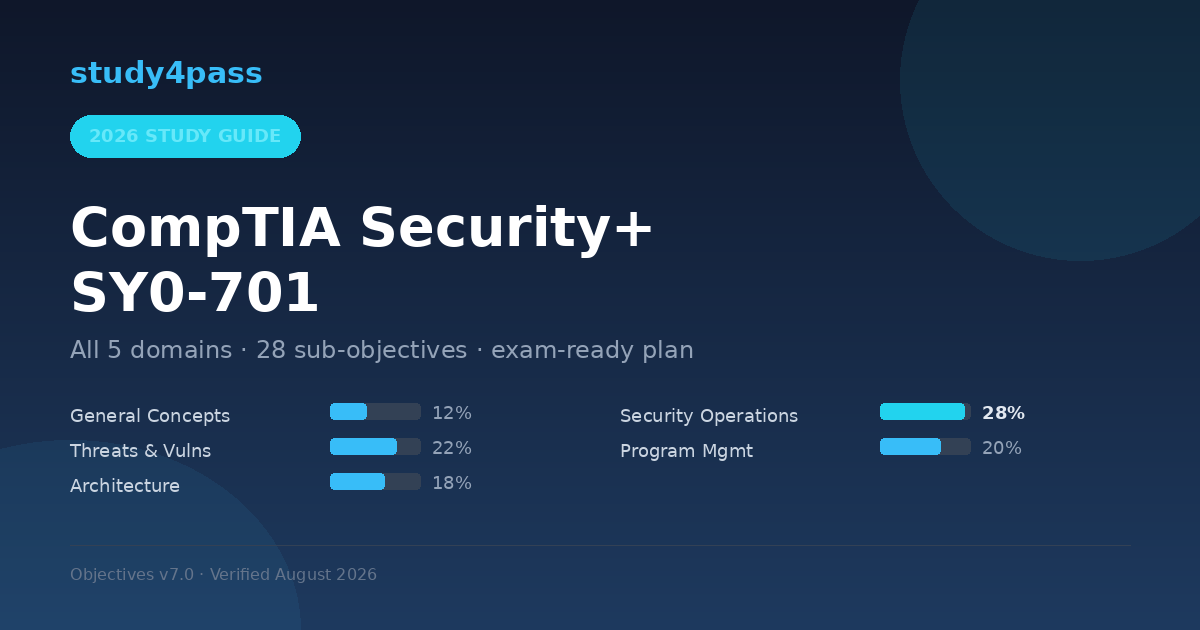
A complete, updated breakdown of the CompTIA Security+ SY0-701 exam objectives, all 5 domains, 28 sub-objectives, current weights — plus how study4pass structures your prep so you pass with confidence." author: "study4pass Certification Instructor Team" objectives_version: "7.0"
CompTIA Security+ SY0-701 Study Guide 2026: How study4pass Helps IT Professionals Prepare
By the study4pass Certification Instructor Team · Last updated August 2026 · Objectives document version 5.0
Table of Contents
- Why This Guide Exists
- SY0-701 Exam at a Glance
- Domain 1: General Security Concepts (12%)
- Domain 2: Threats, Vulnerabilities & Mitigations (22%)
- Domain 3: Security Architecture (18%)
- Domain 4: Security Operations (28%)
- Domain 5: Security Program Management & Oversight (20%)
- Where Candidates Actually Lose Points
- How study4pass Structures Your Preparation
- A Word on Exam Dumps and Authorized Materials
- Frequently Asked Questions
Why This Guide Exists
Search for "Security+ exam objectives" and you'll hit two problems. First, the official blueprint is a PDF that names every topic and explains none of them — useful as a checklist, useless as a study companion. Second, a surprising amount of what ranks online still describes retired exam versions: six-domain structures from SY0-501, or SY0-601's old 24/21/25/16/14 weighting. If a resource can't tell you which version it's teaching, it's probably wasting your study hours.
This guide is built and maintained by the study4pass instructor team, who work with IT professionals preparing for this exam every week. It reflects both the current SY0-701 (V7) blueprint and the patterns we see repeatedly in student practice-test results — not just a restatement of CompTIA's PDF.
SY0-701 Exam at a Glance
Detail Value Exam code SY0-701 (V7) Launched November 7, 2023 Previous version SY0-601 — retired July 31, 2024 Questions Up to 90 Time 90 minutes Question types Multiple-choice + performance-based (PBQs) Passing score 750 (scale of 100–900) Price $425 (US) Renewal 3 years, via CompTIA CE program Objectives document Version 5.0 On SY0-801: training providers have floated a successor arriving as early as late 2026, but CompTIA has not confirmed anything as of this writing. If you're studying now, don't wait — version transitions historically overlap for a long stretch, and a certification earned today stays valid for three years regardless of what launches next.
Other Useful Links about CompTIA Security+ SY0-701
- How difficult is the SY0 701 Azure Fundamentals exam?
- SY0-701 Exam Questions: Which Access Control Model Allows Users To Control Access To Data As An Owner Of That Data?
- Where Can I Find the Best SY0 701 Exam Prep Practice Test 2025 for Verified Reliability?
- Ace SY0-701 Matching anti Malware Solutions to Cybersecurity Threats
- SY0-701 Practice Test Questions: Which Attack Exploits The Three-Way Handshake?
Domain 1: General Security Concepts (12%)
The smallest slice by weight, but its vocabulary reappears inside every other domain's questions — skipping it costs you points elsewhere too.
- Security control types and categories — technical, managerial, operational, physical crossed with preventive, deterrent, detective, corrective, compensating, directive
- Fundamental security concepts — CIA triad, non-repudiation, AAA, gap analysis, and the new centerpiece: zero trust architecture, including the policy engine and policy administrator
- Change management processes — approvals, ownership, technical implications (allow lists, downtime, dependencies), documentation
- Cryptographic solutions — PKI, symmetric vs. asymmetric encryption, key exchange, digital signatures, certificates, hashing, salting, and blockchain
Domain 2: Threats, Vulnerabilities & Mitigations (22%)
The know-your-enemy domain. Questions here are recognition-driven: identify the actor, the vector, the vulnerability, or the indicator from a description.
- Threat actors and motivations — nation-states, unskilled attackers, hacktivists, insiders, organized crime, shadow IT
- Threat vectors and attack surfaces — message-based, image-based, file-based, removable media, supply chain, and the human-vector catalog (phishing, smishing, vishing, pretexting, BEC)
- Vulnerability types — application (buffer overflow, race conditions), OS, web (SQLi, XSS), hardware, virtualization (VM escape), cloud-specific, misconfiguration, zero-day
- Indicators of malicious activity — malware types, network attacks (DDoS, DNS attacks, on-path), application attacks, cryptographic attacks
- Mitigation techniques — segmentation, access control, patching, hardening, least privilege, monitoring
Domain 3: Security Architecture (18%)
The design domain — where you're tested on building secure environments, not just defending them.
- Architecture models — cloud and shared responsibility, IaC, serverless, microservices, on-premises vs. centralized/decentralized, containerization, IoT, ICS/SCADA, RTOS
- Securing enterprise infrastructure — security zones, firewall types, IDS/IPS placement, jump servers, proxies, load balancers, SASE (heavy PBQ territory — expect drag-and-drop topology questions)
- Protecting data — classification, states (at rest, in transit, in use), encryption, hashing, masking, tokenization, data sovereignty
- Resilience and recovery — high availability, hot/warm/cold sites, multi-cloud, RTO/RPO, backups, power redundancy
Domain 4: Security Operations (28%)
The exam's heavyweight — nine sub-objectives, nearly a third of the blueprint, and where most PBQs live. If study time is limited, this is where it goes first.
- Securing computing resources — secure baselines, hardening, wireless security (WPA3, RADIUS), MDM/BYOD, application security, sandboxing
- Asset management — acquisition, ownership, inventory, disposal and sanitization
- Vulnerability management — scanning, CVSS/CVE, patch prioritization, rescanning and validation
- Alerting and monitoring tools — SIEM, DLP, SNMP traps, NetFlow, vulnerability scanners
- Enterprise security configuration — firewall rules, IDS/IPS signatures, DNS filtering, DMARC/DKIM/SPF, EDR/XDR
- Identity and access management — provisioning/de-provisioning, SSO and federation (SAML, OAuth), MFA, privileged access management
- Automation and orchestration — use cases, benefits, and honest costs (complexity, technical debt)
- Incident response — the full lifecycle from preparation through lessons learned, plus digital forensics basics
- Using data sources for investigations — log analysis, packet captures, dashboards
Domain 5: Security Program Management & Oversight (20%)
The governance domain — a full fifth of the exam, and one technical candidates often under-study.
- Security governance — policies, standards, procedures, governance structures, roles (owner, controller, processor, custodian)
- Risk management — qualitative and quantitative analysis (SLE, ALE, ARO), risk register, tolerance vs. appetite, business impact analysis (RTO, RPO, MTTR, MTBF)
- Third-party risk — vendor assessment, agreement types (SLA, MOU, MSA, NDA), vendor monitoring
- Compliance — reporting, non-compliance consequences, privacy obligations
- Audits and assessments — internal vs. external, penetration testing concepts
- Security awareness practices — phishing simulations, user training, insider threat awareness
Where Candidates Actually Lose Points
This is the part a PDF can't tell you. Across the students study4pass instructors work with, the recurring gaps are:
- Underestimating Domain 4. Nine sub-objectives and the highest PBQ density means candidates who study "evenly" across all five domains arrive underprepared for the section worth the most.
- Treating Domain 5 as memorization-only. The risk formulas (SLE × ARO = ALE) and agreement types are memorizable, but scenario questions test whether you can apply them, not just recite them.
- Mixing up exam versions while studying. Students who pull practice questions from old SY0-601 or SY0-501 material waste hours on retired weightings and domain names.
- Skipping PBQ practice until the end. Performance-based questions — ordering firewall rules, placing devices in a topology, reading logs — reward repetition, not last-minute cramming.
How study4pass Structures Your Preparation
study4pass builds its Security+ prep around the same weight-ordered logic outlined above, so IT professionals with limited study windows spend time where the exam actually tests them:
- Start with Security Operations (28%) — the heaviest domain, drilled first with scenario-based practice questions and log-reading exercises.
- Move to Threats, Vulnerabilities & Mitigations (22%) — recognition material reinforced with repetition-based flashcards for attack types.
- Don't postpone Program Management (20%) — dedicated practice sets for risk formulas, agreement types, and audit categories, since this domain is easy to under-study.
- Finish with Architecture (18%) and General Concepts (12%) — rounded out with reference material for the control matrix and cryptography vocabulary.
- Self-score against all 28 objectives, then simulate the full 90-question, 90-minute exam under timed conditions before test day.
This isn't a replacement for the official CompTIA objectives — it's a structured path through them, built from what actually shows up when students take practice exams and miss questions.
A Word on Exam Dumps and Authorized Materials
CompTIA's authorized-materials policy is explicit: candidates who prepare using unauthorized "braindump" content risk having certifications revoked and being suspended from future testing. study4pass's practice tests and study materials are built from the official objectives — not leaked exam content — which protects both your certification and your understanding of the material for the job itself.
Frequently Asked Questions
What are the five Security+ SY0-701 domains and their weights? General Security Concepts (12%), Threats, Vulnerabilities, and Mitigations (22%), Security Architecture (18%), Security Operations (28%), and Security Program Management and Oversight (20%).
How many objectives does the Security+ exam have? 28 sub-objectives across five domains: four in General Security Concepts, five in Threats and Vulnerabilities, four in Security Architecture, nine in Security Operations, and six in Program Management and Oversight.
Is SY0-701 still the current version? Yes. SY0-701 (V7) is the only active version as of August 2026. SY0-601 retired on July 31, 2024. A successor has been rumored but not confirmed by CompTIA.
Does the exam include performance-based questions? Yes. PBQs simulate tasks like ordering firewall rules, placing devices in a network topology, or analyzing logs — concentrated most heavily in the Security Operations domain.
Where can I get the official objectives PDF? Directly from CompTIA's Security+ certification page — always the primary source. This guide annotates it, not replaces it.
study4pass is an independent certification-prep resource and is not affiliated with or endorsed by CompTIA. CompTIA Security+ and SY0-701 are trademarks of CompTIA. This article is reviewed and updated as CompTIA revises the exam objectives.