Free CERTIFIED-DATA-ENGINEER-PROFESSIONAL Databricks CERTIFIED-DATA-ENGINEER-PROFESSIONAL Practice Test Question

Loading demo links...

Showing 19–21 of 26 questions

Question 19 (Topic 1)

What describes integration testing?

Select an option, then click Submit answer.

  • It validates an application use case.
  • It validates behavior of individual elements of an application,
  • It requires an automated testing framework.
  • It validates interactions between subsystems of your application.
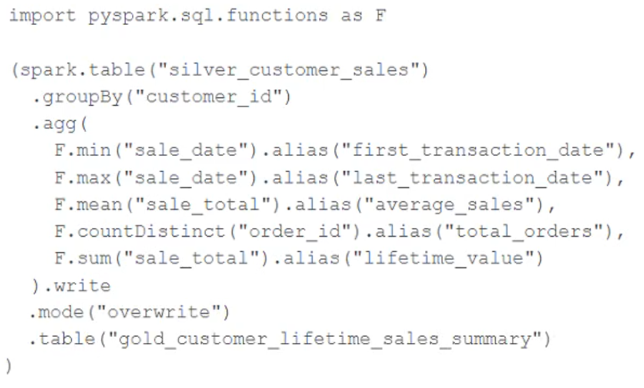
Question 20 (Topic 1)

The data engineering team maintains the following code: Assuming that this code produces logically correct results and the data in the source table has been de-duplicated and validated, which statement describes what will occur when this code is executed?

Select an option, then click Submit answer.

  • The silver_customer_sales table will be overwritten by aggregated values calculated from all records in the gold_customer_lifetime_sales_summary table as a batch job.
  • A batch job will update the gold_customer_lifetime_sales_summary table, replacing only those rows that have different values than the current version of the table, using customer_id as the primary key.
  • The gold_customer_lifetime_sales_summary table will be overwritten by aggregated values calculated from all records in the silver_customer_sales table as a batch job.
  • An incremental job will detect if new rows have been written to the silver_customer_sales table; if new rows are detected, all aggregates will be recalculated and used to overwrite the gold_customer_lifetime_sales_summary table.
Question 21 (Topic 1)

To reduce storage and compute costs, the data engineering team has been tasked with curating a series of aggregate tables leveraged by business intelligence dashboards, customer-facing applications, production machine learning models, and ad hoc analytical queries. The data engineering team has been made aware of new requirements from a customer-facing application, which is the only downstream workload they manage entirely. As a result, an aggregate table used by numerous teams across the organization will need to have a number of fields renamed, and additional fields will also be added. Which of the solutions addresses the situation while minimally interrupting other teams in the organization without increasing the number of tables that need to be managed?

Select an option, then click Submit answer.

  • Send all users notice that the schema for the table will be changing; include in the communication the logic necessary to revert the new table schema to match historic queries.
  • Configure a new table with all the requisite fields and new names and use this as the source for the customer-facing application; create a view that maintains the original data schema and table name by aliasing select fields from the new table.
  • Create a new table with the required schema and new fields and use Delta Lake's deep clone functionality to sync up changes committed to one table to the corresponding table.
  • Replace the current table definition with a logical view defined with the query logic currently writing the aggregate table; create a new table to power the customer-facing application.