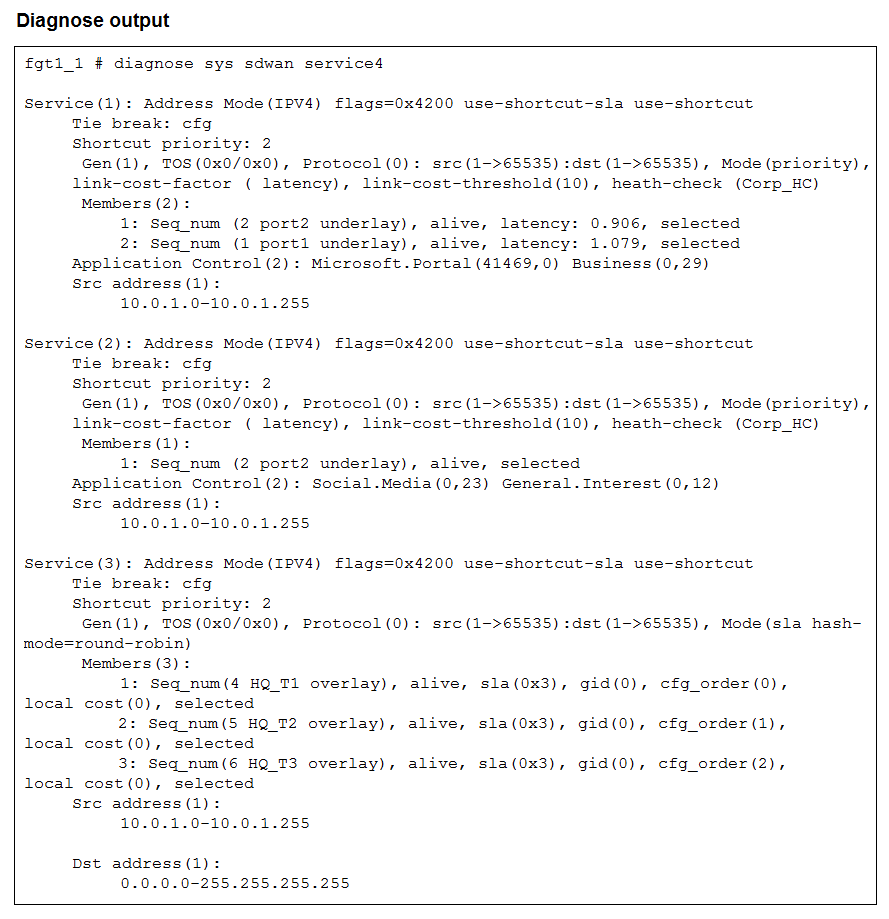
Refer to the exhibit. The exhibit shows output of the command diagnose sys sdwan service4 collected on a FortiGate device The administrator wants to know through which interface FortiGate will steer traffic from local users on subnet 10 0.1.0/255.255.255.192 and with a destination of the social media application Facebook. Based on the exhibits, which two statements are correct? (Choose two.)
Select an option, then click Submit answer.
Reference / correct answer:
FortiGate steers traffic for social media applications according to the service rule 2 and steers traffic through port2.
Most accepted answer: A. FortiGate steers traffic for social media applications according to the service rule 2 and steers traffic through port2.
Community votes: A=4, B=3, D=1
Selected Answer: AB A: service 2 has social media which includes facebook B:Round robing mode for load-balance and all members meet SLA therefore it will be load-balanced Traffic can be load balanced on lowest cost or manual SLA upvoted 1 times
Selected Answer: AB The answer is AB. If it recognizes the traffic as going to Facebook, it will use the rule with service ID 2, and be routed through port 2 per the rule. If it does not recognize the application traffic, it will hit the catch-all rule with service ID rule 3. This uses Lowest Cost SLA and load-balancing for round-robin - all members are alive and meet SLA. Therefore, per page 250 of the SD-WAN 7.4 Architect notes, priority, cost or configuration order will not be considered, and traffic will be load-balanced in circular fashion. upvoted 3 times
Selected Answer: AB A/B are correct because the round-robin mode use all active link upvoted 3 times one_1996 10 months, 1 week ago But the tie-break is set to cfg, so the member with the lowest cfg_order wins, which is HQ_T1. Therefore, the correct answer is D. upvoted 2 times jajajaf342 10 months ago You are mistaken - please update or edit your comment. The answer is AB. Per page 250 of the SD-WAN 7.4 Architect notes: "Note that FortiGate doesn't consider the member cost, priority, and configuration order. With the manual strategy FortiGate considers all members that are alive. With the lowest cost (SLA) strategy, FortiGate considers only the number of SLA targets the member meets." In our case, we use Lowest Cost (SLA) with round-robin - therefore no tie-breakers are considered (in your case, you reference the 'cfg' order, but this doesn't matter in the load-balanced scenario). Only members that meet SLA are considered, and traffic is round-robin'ed through each alive member (all 3). Consider that you MUST set some sort of configuration priority order for members on any SD-WAN rule - if what you were saying were true, it would be IMPOSSIBLE to configure load-balancing in Manual mode, since there will always be a "tie" for all alive members, and consequently all traffic would be routed through the highest configuration priority member (therefore rendering load-balancing impossible). upvoted 1 times ... ...
But the tie-break is set to cfg, so the member with the lowest cfg_order wins, which is HQ_T1. Therefore, the correct answer is D. upvoted 2 times jajajaf342 10 months ago You are mistaken - please update or edit your comment. The answer is AB. Per page 250 of the SD-WAN 7.4 Architect notes: "Note that FortiGate doesn't consider the member cost, priority, and configuration order. With the manual strategy FortiGate considers all members that are alive. With the lowest cost (SLA) strategy, FortiGate considers only the number of SLA targets the member meets." In our case, we use Lowest Cost (SLA) with round-robin - therefore no tie-breakers are considered (in your case, you reference the 'cfg' order, but this doesn't matter in the load-balanced scenario). Only members that meet SLA are considered, and traffic is round-robin'ed through each alive member (all 3). Consider that you MUST set some sort of configuration priority order for members on any SD-WAN rule - if what you were saying were true, it would be IMPOSSIBLE to configure load-balancing in Manual mode, since there will always be a "tie" for all alive members, and consequently all traffic would be routed through the highest configuration priority member (therefore rendering load-balancing impossible). upvoted 1 times ...
You are mistaken - please update or edit your comment. The answer is AB. Per page 250 of the SD-WAN 7.4 Architect notes: "Note that FortiGate doesn't consider the member cost, priority, and configuration order. With the manual strategy FortiGate considers all members that are alive. With the lowest cost (SLA) strategy, FortiGate considers only the number of SLA targets the member meets." In our case, we use Lowest Cost (SLA) with round-robin - therefore no tie-breakers are considered (in your case, you reference the 'cfg' order, but this doesn't matter in the load-balanced scenario). Only members that meet SLA are considered, and traffic is round-robin'ed through each alive member (all 3). Consider that you MUST set some sort of configuration priority order for members on any SD-WAN rule - if what you were saying were true, it would be IMPOSSIBLE to configure load-balancing in Manual mode, since there will always be a "tie" for all alive members, and consequently all traffic would be routed through the highest configuration priority member (therefore rendering load-balancing impossible). upvoted 1 times